

The EV & Automobile Innovation Award
India’s vehicle transition is being decided by cost per kilometre, charging access and battery life in Indian conditions. This category recognises vehicle, battery, charging and mobility innovation judged against those realities.
- Independent jury
- 250
- Innovations evaluated
- 4,500+
- Star rating
- 1–5
- Running since
- 2010
Academics, scientists, officials, investors
Across seventeen editions
Every nominee earns an AGBA Innovation Star
India’s longest-running innovation award
Three categories sit close to data. This is the one about method and evidence.
Most nominations that fail here fail because they were in the wrong category. Read across before you write anything.
Innovation in EV & Automobile
Vehicles, batteries, charging networks and mobility systems, judged on what they do in Indian conditions.
This category
Innovation in Climate Change
Emissions, energy transition and adaptation work where the environmental case is the innovation.
Innovation in Manufacturing
Process, plant and production engineering, including how vehicles and packs are actually built.
Who should enter
- Electric vehicle platforms, powertrains and thermal design
- Battery technology, pack engineering, BMS and second-life work
- Charging and swapping infrastructure with utilisation evidence
- Connected, autonomous and ADAS work validated on Indian roads
- Fleet electrification and shared mobility with operating data
What this award recognises is a vehicle, pack or network that holds up in Indian conditions — heat, dust, duty cycle and cost per kilometre. A specification sheet on its own is not evidence.
If the innovation is in the production process itself, enter Innovation in Manufacturing. If the case rests on emissions or the energy transition, enter Innovation in Climate Change.
What the jury looks for
- Problem definition & market opportunityWhether the innovation solves a real problem, backed by evidence and a measurable impact on its target audience.
- InnovativenessNovelty and uniqueness — new technology, functionality or business model — measured against what already exists, including IP.
- Market potential & impactSize and growth of the addressable market, competitive landscape, and scalability across geographies.
- Social impact & sustainabilityContribution to society and the environment, including social responsibility and the UN Sustainable Development Goals.
These are the same four criteria — problem definition, innovativeness, market impact and social/sustainability impact — used to assess every category. In this category the jury also weighs methodological rigour — including what you did to avoid fooling yourselves — the decision that changed as a result and what it was worth, the reproducibility and honesty of the evaluation, and the engineering quality of the data foundation underneath. Read the full evaluation criteria.
Who judges this category
Nominations are assessed by an independent jury, not by the organisers. Jurors are matched to the categories where their expertise lies. These are among those who read electric vehicle, battery and automobile entries.
 Mr. Randheer SinghDirector, E-Mobility and Advanced Chemistry Cell Programme, NITI Aayog
 Mr. Amit BhattManaging Director for India, International Council on Clean Transportation
 Prof. Rangan BanerjeeForbes Marshall Chair Professor, Energy Science and Engineering, IIT Bombay
 Prof. Sagar MitraProfessor, Energy Science and Engineering, IIT Bombay
 Prof. Asim TewariG.K. Devarajulu Chair Professor, Mechanical Engineering, IIT Bombay
 Prof. Bharat Singh RajpurohitProfessor, Computing and Electrical Engineering, IIT Mandi
 Mr Paresh Kumar GoelDirector, Transport and Road Safety, Ministry of Road Transport and Highways
 Mr. Nikunj SanghiFormer Chairman, Automotive Skills Development Council
Eight of roughly 250. The full panel spans the IITs, the IIMs, the IIITs, the Indian School of Business, NITI Aayog and central ministries, the Department of Science & Technology, MeitY and CERT-In. See the full jury panel.
The transition on the podium
Vehicle and charging work is recognised in both tracks, startup and enterprise. These are the most recent winners, photographed at the ceremony in New Delhi.
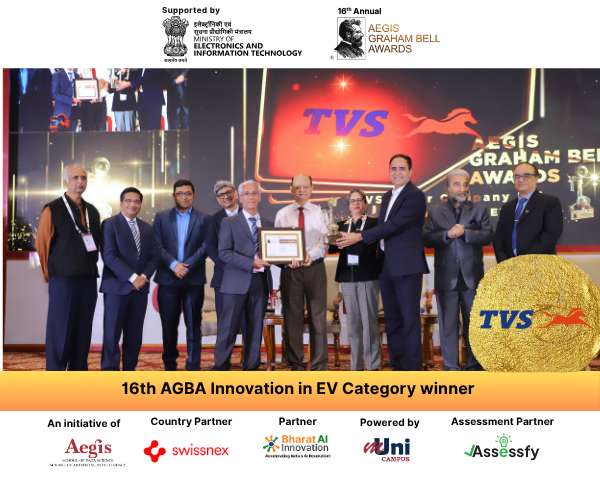
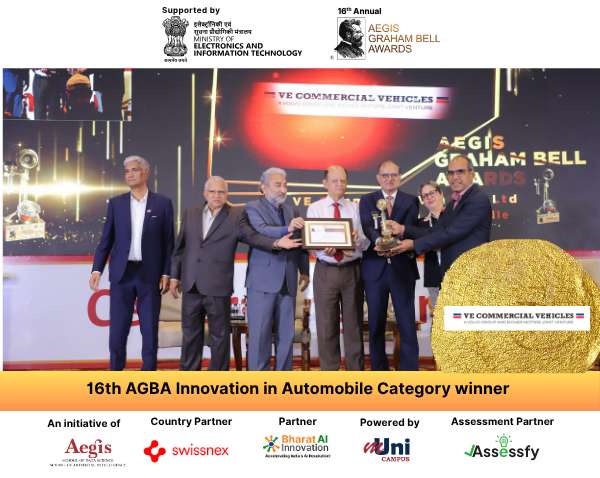
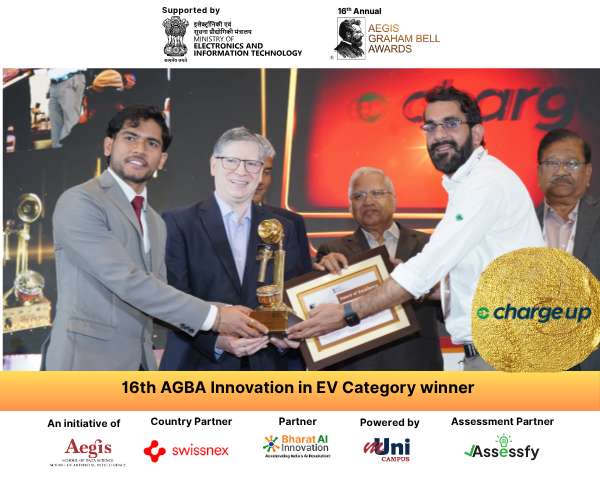
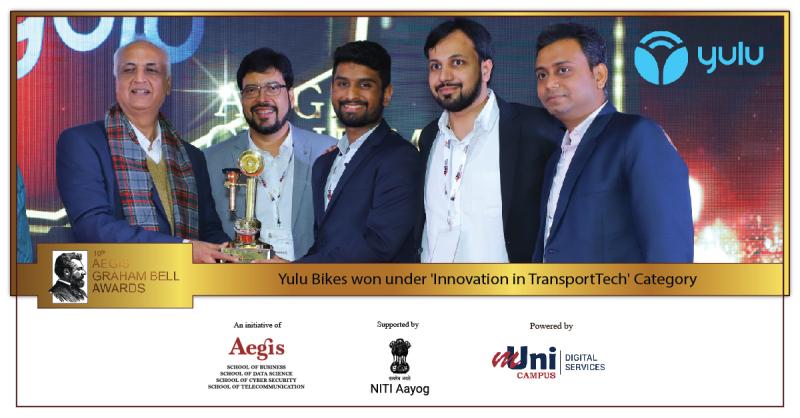
Previous winners
Vehicles, batteries, charging and shared mobility have been recognised across recent editions under several category names — EV, Automobile, Electric Mobility, Battery Tech, Charging Infrastructure and TransportTech. The complete edition by edition record sits in the winners archive.
Category names have changed across editions as the field has moved; the rows above are the closest equivalents in the published record. See the winners archive for the full 1st–16th edition history.
What happens after you submit
-
Stage one · nowNomination registration
Register your company and category through the nomination process, then complete the detailed nomination form and processing fee.
-
Stage twoJury presentation
Present the innovation to the jury and take questions. Jurors score each entry against the four evaluation criteria and rank it within its category.
-
Stage threeStar Certification
Nominees are also assessed for AGBA Innovation Star Certification, an independent maturity rating alongside the category judging.
-
Stage fourFinalists announced
Once every category has been evaluated, finalists are announced on the website ahead of the ceremony.
-
Stage fiveAward ceremony
Winners are honoured on 18 February 2027 at Hotel Ashoka, Chanakyapuri, New Delhi.
Before you write your nomination
Is a component eligible, or only whole vehicles?
Components, packs, power electronics and vehicle software are all read here. What matters is the measurable difference the part makes to the vehicle or the network it runs on.
Does charging infrastructure belong in this category?
Yes. Charging and battery-swapping networks are read here, and utilisation data carries more weight than the number of points installed.
How is autonomous and ADAS work assessed?
On validation. Nominations should say where the system was tested, which conditions were covered and how the safety case was handled on Indian roads.
How do I submit a nomination?
Nominations are submitted through the nomination process, which sets out the stages, the supporting material required and the current edition’s dates.
Put your vehicle work in front of the panel
Nominations for the EV and Automobile Innovation Award are read by an independent jury of engineers, policymakers and industry practitioners. Bring the field data — duty cycles, utilisation, cost per kilometre — rather than the brochure.