

How AI-ready is your organisation, really?
An independent AI-maturity rating that places you on the global maturity curve and maps you to ISO/IEC 42001, the NIST AI RMF, the EU AI Act and India’s DPDP Act. Get your maturity level, your sector percentile, and a board-grade roadmap to move up a tier.
- Readiness pillars
- 6
- Evidence-backed metrics
- 25
- Maturity levels
- 5
- Score, tier & percentile
- 0–100
Strategy through to GenAI & agentic
Non-compensatory, gate-controlled
Nascent → Transformational
Placed on the global curve
Everyone is doing AI. Almost nobody can prove they are ready.
Adoption raced ahead of outcomes. The gap now shows up in wasted capital, not in model quality.
The common thread is not technology. 73% of failed AI projects had no agreed definition of success before they began; projects that set quantified success measures upfront succeed 54% of the time versus 12% without. What is missing is measurement, not models. Stanford’s 2026 Index puts inaccuracy as the number-one cited AI risk at 74% — exactly what the data and model-risk pillars measure.
A narrow elite is capturing the returns
Independent studies put only a small share of organisations at the frontier of AI value.
It stopped being a technical problem. It is now a commercial one.
-
Happening nowDeals you never hear about
Enterprise RFPs increasingly ask suppliers to evidence AI governance. The loss stays invisible until you are already off the list.
-
By Aug 2026EU AI Act high-risk duties bind
If you build or deploy a high-risk system touching the EU, the obligations are live. Readiness work takes longer than the runway left.
-
By May 2027India’s DPDP Rules reach full compliance
Significant Data Fiduciaries owe an annual data-protection impact assessment and algorithmic due diligence covering AI use.
-
Every board meetingDirectors signing off on unseen risk
Boards are asked to accept AI exposure on management’s word. An independent rating is something they can put in the minutes.
The six AI-readiness pillars
From strategy and data to talent, governance, value and the GenAI/agentic frontier — each pillar mapped to India’s DPDP Act & IT Rules, the EU AI Act, the NIST AI RMF and ISO/IEC 42001. Geometric, non-compensatory scoring with critical-control gates means a weak pillar cannot be masked by a strong one.
Strategy & Leadership
AI vision, board-level sponsorship, sustained funding and a prioritised roadmap.
Data & Infrastructure
Data quality and governance, ML platform and MLOps maturity.
Talent, Culture & Adoption
AI literacy, specialist skills, change readiness and workforce adoption — roughly 70% of AI value is people and process.
Governance & Responsible AI
AI policy, the trustworthy-AI dimensions, NIST AI RMF risk management and ISO/IEC 42001 alignment.
Adoption & Value
Use cases in production, measured ROI / EBIT impact, scaling and workflow integration.
GenAI, Agentic AI & AI Security
Generative-AI guardrails, agentic-AI oversight, model risk management, AI security and third-party / foundation-model risk.
How it works
From application to a board-ready roadmap: independent, standards-mapped, and expert-verified at the Verified tier.
- ApplyRegister your organisation and choose your assurance tier.
- SubmitAnswer the maturity workbook and attach evidence across the pillars.
- AssessYour score is computed the moment you submit. Choose Verified and an AGBA assessor verifies a risk-based sample of your evidence before it is certified.
- ScoreYour maturity level, percentile versus the field and standards gap-map are computed.
- RoadmapA board-grade report sets the moves to climb a tier.
The report your board will actually use
Not a dashboard — a strategy document, with role-specific recommendation packs for every leader, grounded in your own scores.
What makes the rating defensible
A maturity rating only has value if the market trusts it and it reflects the standards you will be assessed against.
- Mapped to the standards you will be assessed againstEvery pillar maps to India’s DPDP Act and IT Rules, ISO/IEC 42001, the NIST AI RMF and the EU AI Act — so the rating doubles as a gap map toward certification and compliance.
- Placed on a published curve, not a vanity numberYour score sits on the global maturity curve drawn from BCG, McKinsey and Accenture research, so you see your percentile and the exact distance to the frontier.
- Non-compensatory, with critical-control gatesGeometric scoring means heavy spend on infrastructure cannot mask weak governance. Fail a gate on AI security or agentic oversight and no certification is issued, whatever the total score.
- We assess, and we do not sell the fixAGBA does not sell the remediation it then grades. That separation is what keeps the rating defensible to a board, a customer or an acquirer.
Who is issuing this
A credential is worth exactly what its issuer is worth.
16 editions of the Aegis Graham Bell Awards
Initiated by the Aegis School of Data Science, Cyber Security & Telecom as a tribute to Alexander Graham Bell.
Supported by MeitY
India’s largest innovation award, supported by the Ministry of Electronics & Information Technology, with Skill India and the National Informatics Centre.
Judged by an independent jury
Winners are chosen by a jury with no stake in the outcome. The same discipline governs the AI Readiness rating.
India is writing the rules right now. MeitY and UNESCO ran the AI Readiness Assessment Methodology across India from 2024, under the IndiaAI Mission with NITI Aayog in the policy direction. UNESCO assesses countries; we assess organisations — in the same language your regulator already uses.
Certified organisations are felicitated on stage
A credential earns more when it is conferred in public. Every AI Readiness Certification holder is felicitated at Bharat AI Innovation — India’s AI conference and exhibition — not emailed as a PDF.
Your certification is handed over on stage in front of peers, press and policymakers — where your buyers, partners and government stakeholders already gather. Certify before the cycle closes to be felicitated at Bharat AI Innovation, 20–21 November 2026.
Part of the AGBA Certification & Index
Readiness tells you how AI-ready you are. Two companion assessments complete the picture — the risk and governance posture of each live AI system, and where your company ranks on innovation. Same evidence-gated, independently-reviewed AGBA rigour.
Bharat AI Risk & Governance
A per-AI-system conformity-readiness rating mapped to India’s DPDP Act, the MeitY India AI Governance Guidelines (2025), the EU AI Act, NIST AI RMF and ISO/IEC 42001 — the controls that stand between your systems and the regulators.
AGBA India Innovation Index
An independent company-level innovation rating across strategy, capability, portfolio, culture and impact — with your sector and national rank and a board-grade report. The wider frame around your AI readiness.
What you actually receive
The certificate issued on completion, carrying your organisation’s readiness index, maturity level, and validity window.
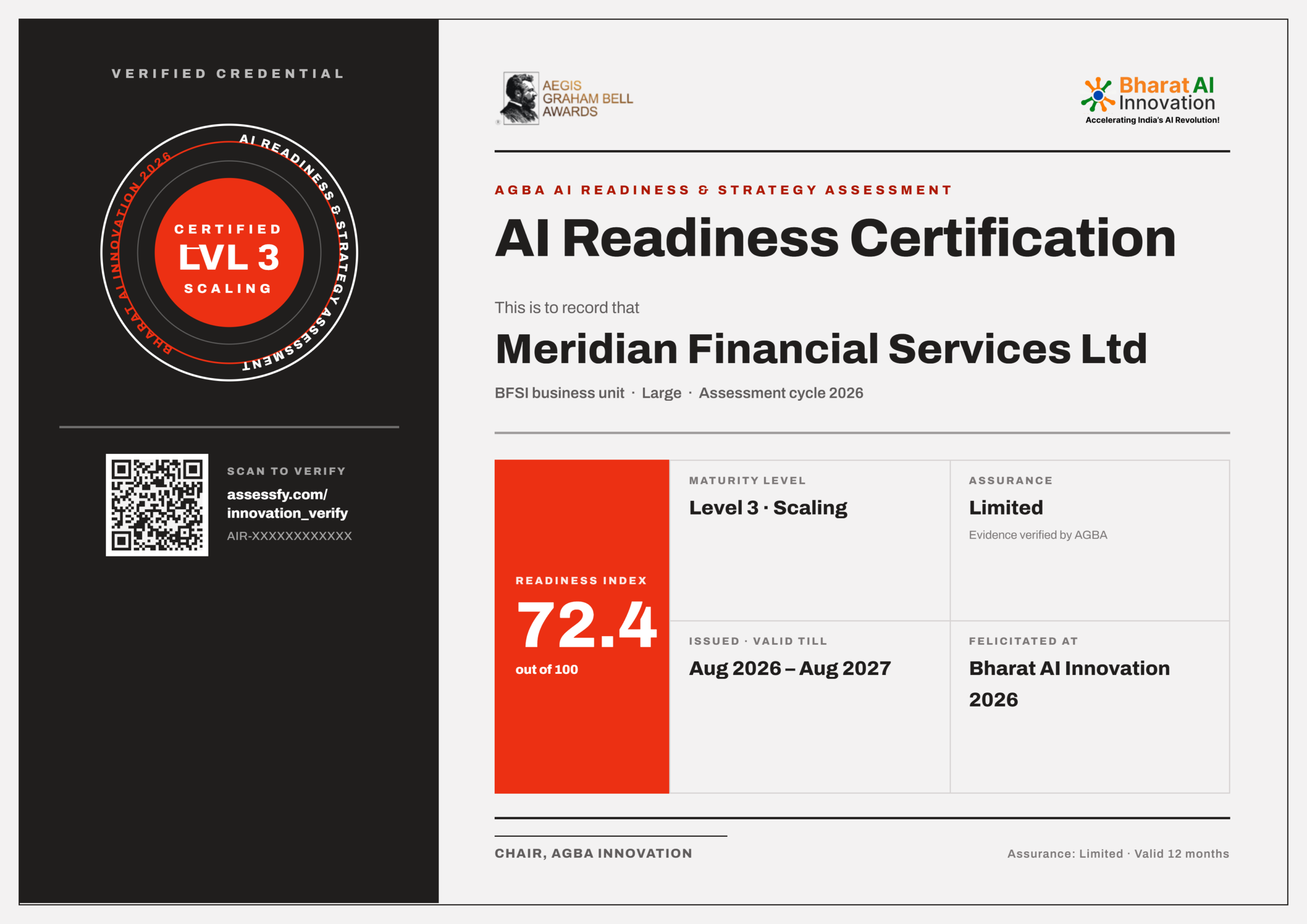
Specimen shown for illustration. Your certificate will carry your organisation’s name, assessed readiness index, maturity level, and a unique verification QR code.
Questions buyers actually ask
What does it cost?
The Readiness Rating is free at every size — a full scored report, your maturity level and a standards gap-map, with no card required. Verified Certification starts at ₹25,000 and scales with annual turnover, so a startup and a ₹1,000-crore group do not pay the same.
How long is the certification valid?
Twelve months from the date of issue. After that the credential shows as expired on its public verification page and drops out of the public registry — AI readiness moves too fast for an open-ended claim to mean anything.
What is the difference between the free rating and the certification?
The rating is self-declared: you answer, the engine scores, you get the report. The certification adds independent verification — an assessor reviews a sample of your evidence before anything is issued — plus a verifiable badge and a listing in the public registry. Only the certification is a credential you can show a buyer or a board.
What do you actually measure?
25 metrics across 6 pillars, mapped to ISO/IEC 42001, the NIST AI RMF, the EU AI Act and India’s DPDP Act. Every weight and formula is published in the full methodology.
Can we just rate ourselves highly and pass?
No. Scoring is non-compensatory — a weak critical control caps your result no matter how strong everything else is — and a certification additionally requires that an assessor has verified evidence. A high self-rating with nothing behind it produces a rating, not a certification.
Who sees the result?
You do. Nothing is published unless you earn a certification and it is issued; only then does the credential appear on its verification page and in the public registry. The free rating is private to you.
What happens after we are certified?
You get the verifiable credential and badge, a listing in the public registry, and certified organisations are felicitated on stage at Bharat AI Innovation.
Find out exactly how AI-ready you are — and how to climb.
Get an independent maturity rating benchmarked against the world’s best, with the roadmap to move up a tier.